By Grandía J. (Agro-Test-Control), Sarasa R. (Inneara consultoria), Bruguera M. y García, A. (Agrifirm)
Weaning is a very critical phase in the productive life of piglets, with various factors causing them social, environmental, and nutritional stress, which compromises their health status, physiological functioning, and, consequently, the proper development of their productive parameters.
For this reason, piglets often show reduced growth and are more susceptible to disease. Because their digestive system is still immature, undigested protein reaches the large intestine where it is available to pathogenic bacteria, causing inflammation and oxidative stress. If this oxidative stress can be reduced at all levels, it is possible to obtain healthier animals with greater well-being and better performance.
Objectives
The objective was to demonstrate the efficacy of Vitanox as an antioxidant based on natural polyphenols in transition piglets, thereby protecting enterocytes from oxidation and preserving the integrity of the intestinal barrier. The study also sought to demonstrate the product’s effect on improving intestinal health in order to prevent possible passage of germs into the circulatory system, boosting the piglet’s immune status and its repair for different challenges (pathogens) (Scott A.Dee, 2020).
Materials and methods
On a farm with confirmed PRRS, based on blood serum pools from five recently weaned animals and PCR analysis, 1,110 animals were selected and distributed across 24 pens (555 animals in 12 pens in each control and test group). During the transition phase, the following production parameters were recorded: weight per pen (upon entry of the animals, at the change from pre-starter to starter feed, and at the end of the transition), mortality control, and feed consumption per pen. Using this data, the average daily gain (ADG) and feed conversion ratio (FCR) per pen were calculated.
A comprehensive stool quality control plan was also carried out through visual inspection: daily for up to 5 days after the diet change (both at the start of the trial and at the change from pre-starter to starter), and then every two days for the rest of the trial. In addition, a necropsy was performed on one animal per pen (12 animals per group, 24 in total) at the end of the transition period for macroscopic observation of the intestine and organs (liver) and to study villus length, crypt depth, and ratio.
On the other hand, in the laboratory, the protein oxidation index (ROS and TBARS; Carl A Frame, 2020) was measured as an indicator of oxidative stress, and occludin (Nienke de Groot, 2021) was analyzed by qPCR with SYBRgreen chemistry normalized with beta-actin. Livak calculations were used for the numerical calculation of gene expression: double deltaCt and a Log2 result. Finally, in one animal per pen (24 animals in total, 12 per group), different from those in the previous study, a study was conducted to measure intestinal permeability using ovalbumin. The test consisted of introducing a precise and known amount of ovalbumin via a gastric tube and measuring the amount absorbed into the blood.
Results
Weights were recorded at the start, feed change, and end of transition, with the average data per animal shown in Table 1, divided by phase and differentiated by males and females. The comparative study shows that the test group started with an initial and intermediate weight lower than that of the control group, but at the end of the transition, the average weight achieved with the product exceeded the weight of the control animals (16.40 kg on average compared to 15.81 kg for the control group).
| Control | Test | All | Difference | |
|---|---|---|---|---|
| Start | 7.13 | 6.97 | 7.05 | 0.16 |
| – Females | 6.94 | 7.23 | 7.10 | -0.29 |
| – Males | 7.28 | 6.65 | 7.00 | 0.63 |
| Intermediate | 10.12 | 9.89 | 10.00 | 0.22 |
| – Females | 10.17 | 10.58 | 10.40 | -0.41 |
| – Males | 10.07 | 9.06 | 9.61 | 1.01 |
| Final | 15.81 | 16.40 | 16.10 | –0.59 |
| – Females | 15.62 | 16.67 | 16.18 | -1.05 |
| – Males | 16.62 | 16.08 | 16.02 | -0.10 |
Analyzing by sex, it should be noted that the females that consumed the product achieved a higher weight throughout the transition than the control females, regardless of the time of weighing (beginning, middle, and end of transition), although with a greater difference in the last weighing (they left the transition with an average difference of 1.05 kg more). In contrast, the opposite occurred in males, with the average weight in the treated group being lower than in the control group at all weighing times, except at the end of the transition. By analyzing the growth in each phase, the data shown in Table 2 was extracted. Overall, it was observed that growth improved from the midpoint of the transition, which is why there was an improvement in growth in the test group between the end and the midpoint and initial points.
| Control | Test | |
|---|---|---|
| Start | 2.99 | 2.92 |
| – Females | 3.23 | 3.35 |
| – Males | 2.79 | 2.41 |
| Intermediate | 5.70 | 6.51 |
| – Females | 5.45 | 6.09 |
| – Males | 2.79 | 2.41 |
| Final | 8.68 | 9.43 |
| – Females | 8.68 | 9.44 |
| – Males | 8.69 | 9.42 |
These data were associated with an improvement in average daily gain and feed conversion ratio in the test group compared to the control group, as shown in Table 3.
| Average Daily Gain (gr/day) | Average Daily Gain (gr/day) | Feed conversion (%) | Feed conversion (%) |
|---|---|---|---|
| Control | Test | Control | Test |
| 0.324 | 0.342 | 1.40 | 1.33 |
With regard to deaths, a higher percentage was observed in the test group (3.6%) than in the control group (2.9%), without any known cause. In the stool study, in all observations made according to the guidelines described in the work plan, no differences were found between phases or groups, either in consistency or in the presence of diarrhea. All planned necropsies were performed, with no significant differences found in the macroscopic observation of the intestine or in the measurements of villi and crypts, as shown in Table 4.

In the laboratory analysis results, no significant differences were observed in the comparative study of oxidation parameters (ROS, TBARS) or in occludin, as shown in Figure 1.
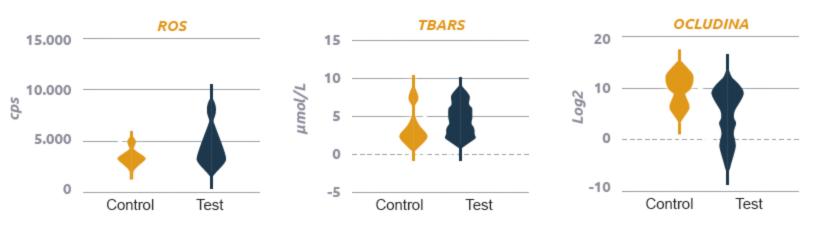
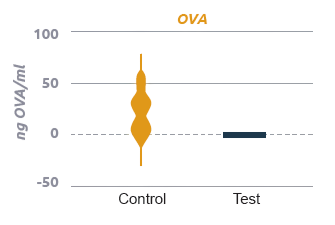
Finally, in the results of ovalbumin quantification for the assessment of intestinal permeability, statistically significant differences were found in the results (p=0.0018) without demonstrating the presence of ovalbumin in any of the samples from the test group, as shown in Figure 2.
Conclusion
Animals fed with Vitanox have shown notable improvements in their productive performance, particularly in terms of growth values. This effect has been more evident in females, who have achieved higher growth rates compared to control groups. These improvements have been reflected in higher average daily weight gain, indicating more efficient utilization of ingested nutrients. In addition, a decrease in feed conversion ratio has been observed, meaning that animals require less feed to achieve greater body weight, resulting in more efficient and profitable production.
On the other hand, the use of the product has also shown significant benefits for the intestinal tract and the immune system. Animals that have consumed Vitanox have shown a reduction in intestinal permeability, which prevents pathogens and toxins from passing from the intestine into the bloodstream. As a result, the risk of infections and digestive problems is reduced, contributing to better overall health on the farm.