Written by Vincent Jacquier, Category Specialist Polyphenols
Longer laying cycles are becoming the new standard in egg production. Cycles that once ended at week 60 or 70 are increasingly extended to 100 weeks and beyond. This shift is driven by straightforward economics: housing, pullet costs, and flock management all favor keeping productive hens longer.
However, extended cycles create a biological challenge that conventional nutrition was not designed to meet. The core objective in a long-cycle flock is persistence: maintaining an acceptable lay rate, with consistent egg quality and a much longer timeline than was typical a generation ago. A hen at 90 weeks is not the same animal she was at 30 weeks. Her metabolism has been running a demanding production program for a long time, and the cumulative effects begin to show. Oxidative stress accumulates, intestinal function declines, immune competence weakens, and feed efficiency deteriorates.
None of these changes are sudden, nor inevitable. But if left unaddressed, they translate gradually into lower performance and reduced profitability. Maintaining a good metabolic function throughout this extended period is therefore essential – not only to sustain egg production, but also to ensure egg quality and production efficiency over time.
Where nutrition can make a difference
One of the key questions is whether targeted supplementation can help slow or mitigate the biological decline in aging laying hens. Polyphenol- and phytogenic-based ingredients have attracted growing interest because they appear to influence a range of physiological systems, particularly gut health, antioxidant status, and immune function. These are precisely the systems most under pressure in ageing, high-producing hens.
Vitanox is a feed ingredient and a powerful natural antioxidant developed with this multi-target approach in mind. Its formulation combines polyphenols and phytogenic compounds selected for their ability to simultaneously act across multiple biological pathways, with a main focus on enhancing gut integrity and upregulating antioxidant defenses of laying hens. Rather than addressing a single nutritional deficiency, the objective is broader metabolic support during a phase in the laying cycle when multiple biological systems are under pressure at once.
Supporting gut function in aging hens
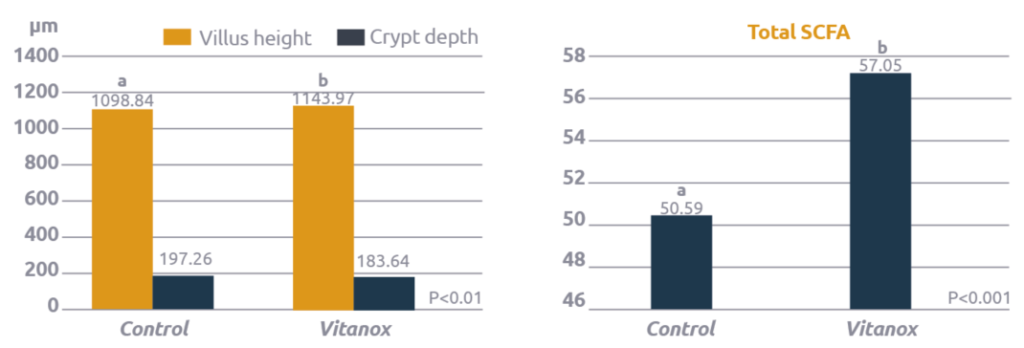
One of the most direct effects of Vitanox is its potential impact on the gut. In a trial conducted at Ankara University using Lohmann LSL Classic hens between 55 and 80 weeks of age, hens receiving Vitanox at 1 kg per metric ton showed measurably better intestinal morphology compared with the control group. Villus height were higher and crypt depth lower, indicating a larger absorptive surface area (P < 0.01). Cecal short-chain fatty acid (SCFA) concentrations were also significantly higher in supplemented hens (P < 0.001). SCFAs, produced by microbial fermentation of fiber in the hindgut, support the intestinal barrier function, local immune regulation and overall energy metabolism. In older hens with sustained metabolic demands, this contribution to an efficient energy balance is meaningful. Higher SCFA concentrations therefore point to a more active, functional stable cecal microbiota capable of better supporting intestinal and metabolic health over time.
Building antioxidant resilience over time
Sustained egg production is metabolically intensive, and oxidative stress is an inevitable consequence of high production intensity. The reactive oxygen species (ROS) generated by high metabolic activity accumulate over time, gradually impairing cellular function, immune capacity, and tissue integrity. Over an 80-week cycle, this accumulation becomes one of the more significant biological constraints a hen faces.
This is where the polyphenolic component of Vitanox plays a central role. Polyphenols are recognized as modulators of endogenous antioxidant pathways. Rather than acting as free radical scavengers, they help stimulate the hen’s own enzymatic defenses. As in many species, including humans, the natural secretion of antioxidant enzymes tends to decline with age.
The data from the control group in the laying hens study makes this visible (figure 2): a gradual decrease in antioxidant enzyme activity over the 25-week observation period, reflecting. This corresponds with the expected biological trajectory of ageing birds. In contrast, hens supplemented with Vitanox maintained stable levels of glutathione peroxidase (GPx) and catalase (CAT) activity. The age-related decrease observed in the control group was effectively prevented.
Superoxide dismutase (SOD) activity showed an even more notable response. By week 80, it was significantly higher compared to controls (P < 0.05), suggesting active upregulation of this key enzymatic defense rather than simply a preservation of baseline function.
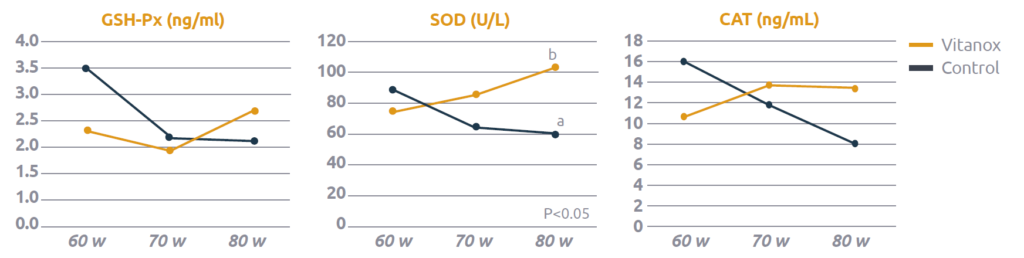
The pattern is meaningful. The results suggest that Vitanox does not appear to deliver a single acute antioxidant effect. Instead, it progressively reinforces the hen’s intrinsic capacity to manage oxidative stress over time, counteracting a decline that would otherwise be considered a normal consequence of aging. For a long production cycle, that kind of sustained, cumulative protection is precisely what is needed.
Better biological function supports better performance
The gut and antioxidant effects are the mechanism behind what a farmer actually cares about. A hen with a healthier gut absorbs nutrients more efficiently. A hen with improved oxidative stress management is more able to maintain her metabolic function over time. Together, these two elements directly contribute to improved production results.
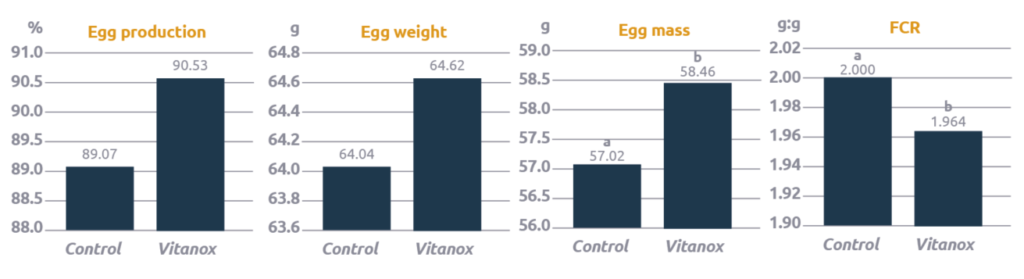
The results in Figure 3 demonstrate this. Hens receiving Vitanox achieved approximately 1.5 additional percentage points in laying rate, with egg weight numerically higher by 0.58 g compared to the control group. Combined, these two effects resulted in a significant 2.5% increase in egg mass (58.46 g versus 57.02 g; P < 0.05). At the same time, feed conversion ratio improved significantly by 3.3% (1.934 versus 2.000; P < 0.05), meaning hens produced more egg mass while eating relatively less, which feeds directly into the cost per dozen eggs.
What makes these results particularly relevant is their consistency. Production rate, egg weight, egg mass, and feed efficiency all improved in the same direction. For the farmer, the bottom line is straightforward: more eggs, heavier eggs, and a lower amount of feed to produce them. When maintained over a long cycle, that combination can have a real and compounding effect on revenue.
Supporting persistence in extended laying cycles
As production cycles continue extending beyond 80 weeks, maintaining lay persistence and egg quality over the long term becomes increasingly important in flock management. Conventional nutrition may not provide sufficient support for the biological systems that determine that persistence across an extended cycle. Supporting gut integrity, metabolic efficiency, and antioxidant resilience becomes increasingly relevant as hens age.
Vitanox, used at 1 kg per metric ton, is developed to provide exactly that support. The objective is not to push hens harder, but to help them maintain the metabolic condition needed to sustain performance over time. The hens that maintain their performance to week 100 are often the ones that age the best.
Download our brochure to find out more about Vitanox: