By Marta Bruguera Bonfill, Global Technical Lead Swine, Wim Wanzele, Nutritional Specialist, & Arlo Ploumen, Technical Sales
Streptococcus suis remains one of the most important bacterial health challenges in global swine production. Despite decades of research and control efforts, it continues to cause significant economic losses through mortality, reduced performance, treatment costs, while also contributing to increased antimicrobial use. The challenge is further complicated by increasing antimicrobial resistance and the absence of a universally effective vaccine.
What makes S. suis particularly difficult to control is that it cannot be viewed as a bacterial problem alone. Disease outbreaks occur when pathogen pressure, pig susceptibility, and external stressors converge. As a result, successful control strategies require a broad approach that combines biosecurity, management, nutrition, and health interventions.
When does S. suis become a problem?
One of the most striking features of S. suis is that nearly all pigs become carriers, yet only a small proportion develop clinical disease. The bacterium is commonly present in the upper respiratory tract without causing disease, but is also found in the gastrointestinal and genital tracts. Clinical problems arise when the balance between the pathogen, the host, and the environment is disrupted.
Stress plays a central role in this process. Weaning, animal mixing, dietary changes, environmental fluctuations, transportation, poor ventilation, co-infections, and compromised immunity can all increase susceptibility. Under these circumstances, S. suis can cross mucosal barriers, enter the bloodstream, and spread throughout the body, resulting in septicemia, meningitis, arthritis, pneumonia, endocarditis, and sudden death.
Direct control is difficult because S. suis is genetically diverse, antimicrobial resistance is increasing, and no universally effective vaccine is available. Vaccination can contribute to disease prevention, but the coexistence of multiple serotypes and strains may limit its efficacy. As a result, successful control strategies focus on reducing the factors that allow it to become pathogenic.
Farm management: the first line of defense
Transmission occurs through multiple routes, including direct contact, aerosols, faeces, contaminated equipment and water, wounds, flies, and vertical transmission from sow to piglet. Clinically healthy carrier animals can also introduce new S. suis strains into a herd without showing clinical signs.
Because S. suis can spread through direct contact and enter the body through wounds and damaged mucosal surfaces, reducing transmission opportunities remains one of the most effective ways to lower disease pressure. This starts in the farrowing house, where thorough cleaning, disinfection, and strict hygiene during farrowing help reduce bacterial exposure during the piglet’s first days of life. Attention should also be paid to routine management procedures. Practices such as castration, tail docking, teeth grinding, and repeated injections create wounds that may serve as entry points for pathogens. Limiting unnecessary mixing of animals and maintaining strong biosecurity throughout the production cycle can further reduce infection pressure.
Management should also focus on minimizing stress. This is particularly important during weaning, when piglets face multiple challenges simultaneously, including separation from the sow, dietary and environmental changes, transport, and social mixing. Supporting piglets through this transition helps maintain resilience and reduces the likelihood that S. suis will progress from commensal colonization to clinical disease.
Building resilient pigs through nutrition
While management reduces pathogen exposure, nutrition plays a crucial role in improving the pig’s ability to cope with S. suis challenges.
It starts with the sow. Sow nutrition influences fetal development, birth weight, piglet vitality, colostrum production, and microbiome transfer. Piglets with strong passive immunity are generally better equipped to withstand infectious challenges later in life.
Colostrum management is particularly important. Modern sow genetics have significantly increased litter size, but colostrum production has not increased proportionally. Ensuring that every piglet receives sufficient high-quality colostrum therefore remains a critical priority on modern pig farms.
Nutrition can also influence the development of the gut microbiome. Through microbiome transfer from sow to piglet, the maternal microbiome helps establish a balanced microbial population in early life, supporting gut development and immune maturation.
The integrity of the gut barrier is another key factor. As long as S. suis remains confined to mucosal surfaces, disease is unlikely to occur. Problems arise when stressors compromise barrier function and allow bacteria to translocate into the bloodstream. Nutritional strategies should therefore focus on supporting microbiome balance, maintaining barrier integrity, and promoting immune competence.
The gut-lung axis: a broader role for gut health
Beyond its role in digestive health, the gut also influences broader immune function. Research increasingly shows that the gut and lungs are connected through the gut-lung axis, a twoway communication network linking intestinal and respiratory health through immune and metabolic signaling pathways.
For S. suis, this is particularly relevant. Stressors such as dietary changes, inflammation, heat stress, poor gut health, or respiratory challenges can compromise barrier function and increase the risk of bacterial translocation. Supporting gut health may therefore contribute not only to digestive function, but also to broader immune resilience.
Supporting immunity with C-Vita: a practical example
One way to support sow immunity and piglet resilience is through targeted nutritional interventions such as C‑Vita, a blend of medium-chain fatty acids (MCFAs) that can support immune function and colostrum quality.
Around farrowing, sows experience increased physiological demands and a natural decline in immune responsiveness. Traditionally, nutritional support has focused on antioxidants such as vitamin E, selenium, zinc, and polyphenols. The inclusion of MCFAs offers an additional approach to supporting immune function during this critical period.
Research has shown that supplementation with C‑Vita during gestation can improve both colostrum production and colostrum quality. Improved immunoglobulin transfer was associated with higher immunocrit values and fewer piglets with critically low levels of passive immunity. Across multiple studies and field observations, improvements in daily gain, lower diarrhea incidence, and reduced pre-weaning mortality were also observed.
Multiple sow farms provide practical evidence of how nutritional support and management can work together. Following the implementation of stricter hygiene measures and the introduction of C‑Vita in sow diets, the number of weaned piglets usually increases, and antibiotic use declines substantially.
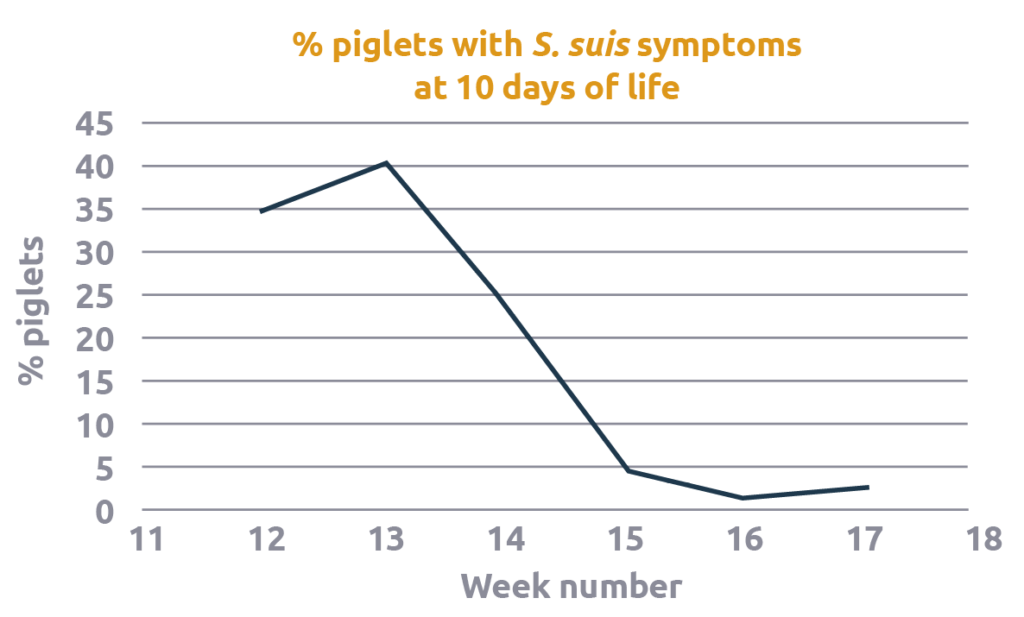
These results highlight an important principle: no single intervention controls S. suis. The greatest benefits are achieved when nutrition and management work together to improve overall pig resilience.
Conclusion
Streptococcus suis is not simply a bacterial disease; it is a multifactorial challenge driven by the interaction between pathogen pressure, pig susceptibility, and environmental stressors. Its high genetic diversity, widespread carrier status, increasing antimicrobial resistance, and the lack of a universally effective vaccine make direct control difficult.
The most effective strategies therefore focus on reducing the conditions that allow the bacterium to become pathogenic. Strong biosecurity, sound management, adequate colostrum intake, robust gut health, and nutritional programs that support immunity all contribute to building more resilient pigs.
Ultimately, controlling S. suis is not about eliminating the bacterium from the farm, but about preventing it from causing disease. By addressing management, nutrition, environment, and herd health simultaneously, producers can reduce clinical outbreaks, lower antibiotic use, and achieve more consistent health and performance outcomes.
Looking to strengthen pig resilience through nutrition and management? Our specialists are happy to help you translate these insights into an integrated approach that supports health and performance throughout the production cycle.