By Vincent Jacquier, Researcher Specialties & Category Specialist Poultry
Feed represents up to 70% of total broiler production costs, making nutrient utilization a key driver of profitability and sustainability. Phytogenic feed additives can support digestive efficiency, but their effects may be expressed through different performance outcomes. Understanding these differences helps producers and nutritionists select strategies that match their production objectives.
Nutrient utilization as the foundation of performance
Feed efficiency and growth performance both depend on the animal’s ability to digest, absorb, and utilize nutrients effectively. However, the desired outcome may vary across production systems.
Some producers focus primarily on reducing feed cost per kilogram of meat produced and therefore prioritize Feed Conversion Ratio (FCR). Other producers prioritize body weight gain (BWG), aiming to achieve higher market weights or improve processing yields.
Because production goals differ, nutritional strategies should be selected accordingly. Rather than applying a single nutritional strategy across all situations, producers increasingly seek technologies that target specific performance outcomes. Whether the objective is improved feed efficiency or enhanced growth performance, the selected nutritional solution should support the desired result.
Why consistency matters in phytogenic nutrition
Over the past decade, phytogenic feed additives have become recognized tools for supporting digestive function and nutrient utilization in poultry production. Among these, essential oils have attracted particular interest because of their ability to stimulate digestive processes, support gut functionality, and improve nutrient availability.
However, demonstrating efficacy under experimental conditions is only part of the equation. Poultry producers need solutions that perform consistently across different feed formulations, management systems, environmental conditions, and geographical regions. Responses observed under controlled experimental conditions do not always translate directly to commercial production environments.
This is where large-scale meta-analysis provides valuable insight. By combining data from multiple independent studies, researchers can assess the reliability and repeatability of a product’s performance under diverse commercial conditions.
This approach was used to evaluate two phytogenic feed additives based on selected essential oils: Supplant D and I-Prove.
Supplant D: targeting feed efficiency
Supplant D combines three encapsulated essential oils selected for their complementary effects on digestive efficiency and nutrient utilization. Encapsulation protects the active compounds during feed processing and enables their targeted release through the digestive tract where digestion and nutrient absorption occur.
The product was evaluated using data from multiple broiler trials conducted under varying geographical, nutritional, and management conditions. A pooled ANOVA analysis of independent studies was used to assess performance consistently across these different environments.
The findings were presented by Dr. Vincent Jacquier at the World Poultry Congress (WPC) 2026 in Toronto, Canada. The presentation, titled “Effect of an Essential Oil Blend on Broiler Performance: Results of a Pooled ANOVA Analysis”, focused on the consistency and reliability of phytogenic feed additives under practical production conditions.
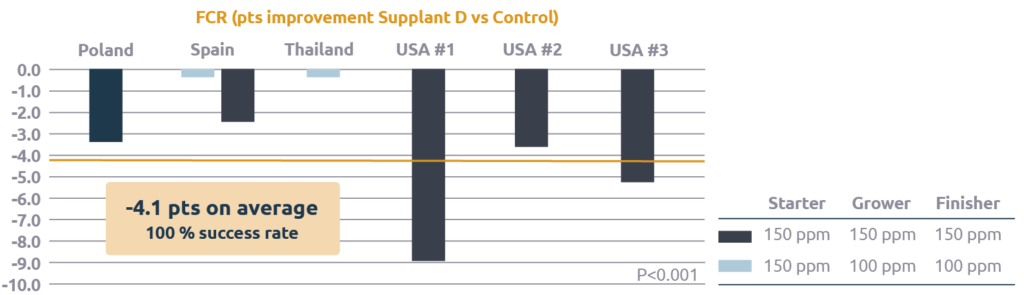
Across all evaluated trials, Supplant D significantly improved FCR by an average of 4.1 points. Importantly, every study included in the analysis reported a positive response, resulting in a 100% success rate.
This level of consistency is notable given the variability typically encountered in commercial poultry production, where genetics, feed formulation, health status, climate, and management practices can all influence nutritional responses. Despite these differences, Supplant D delivered consistently improved feed efficiency across all studies included in the analysis.
For producers managing rising feed costs, even relatively small improvements in FCR can have a substantial economic impact. Based on the analyzed data improved nutrient utilization and reduced feed use per kilogram of weight gain generated an estimated return on investment approaching 10:1.
I-Prove: supporting higher growth performance
While feed efficiency remains an important objective, some production systems place greater emphasis on maximizing growth performance. I-Prove was developed with this goal in mind. The product combines seven essential oils with a dedicated stabilizing technology designed to preserve the integrity and activity of sensitive plant compounds throughout feed manufacturing and storage. Its broader phytogenic spectrum enables activity across multiple physiological mechanisms linked to nutrient utilization, digestive functionality, and growth performance.
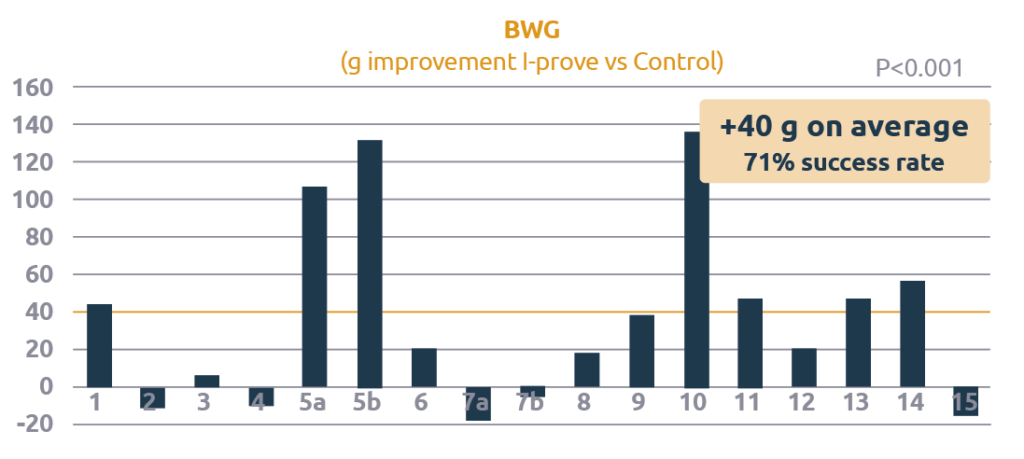
A meta-analysis including 15 trials demonstrated a significant increase in body weight gain, with birds gaining an average of 40 g more than controls. Positive responses were observed in 75% of the evaluated studies, supporting the product’s reliability across various production environments.
Although an additional 40 g per bird may appear limited on an individual basis, the cumulative effect at commercial scale can be substantial. Increased saleable meat yield, combined with efficient nutrient utilization, generated a calculated return on investment approaching 10:1.
For producers whose priority is maximizing growth performance and achieving higher market weights, I-Prove provides a nutritional strategy supported by extensive trial data.
Choosing the right tool
The comparison between Supplant D and I-Prove illustrates an important principle in modern poultry nutrition: improving nutrient utilization can translate into different performance outcomes depending on the technology
used.
Supplant D consistently expressed its value through enhanced feed conversion efficiency, making it particularly relevant when feed costs are the primary concern. I-Prove, in contrast, delivered its benefits mainly through improved body weight gain and may therefore be better aligned with production systems seeking higher market weights and greater output.
Although their performance profiles differ, both solutions share a common characteristic: predictable performance supported by extensive meta-analysis rather than isolated trial outcomes. These datasets demonstrate repeatable results across different production contexts.
Conclusion
Improving nutrient utilization remains one of the most effective ways to enhance broiler performance and profitability. However, performance improvements can be expressed through different outcomes depending on the nutritional approach employed. The meta-analyses presented here show that phytogenic feed additives can consistently support either feed efficiency or body weight gain across a range of production conditions. Selecting the most appropriate approach depends on the production objectives and economic priorities of the operation.