Written by Romain D’Inca, Category Specialist MCFA
In pig production, virus contamination on a farm represents one of the biggest threats. Even with preventive measures in place, outbreaks cannot be predicted but can lead to severe economic consequences, such as bankruptcy. Therefore, biosecurity must be a constant focus. To better understand and prioritize biosecurity risks, veterinarians and scientists work on probabilistic models. Recent cases of African Swine Fever (ASF) contamination in South Korea confirmed that when probabilistic models turn into a real-world event, the importance of feed safety cannot be underestimated.
Viral diseases continue to challenge global pig production
African Swine Fever (ASF), Porcine Epidemic Diarrhea, Porcine Reproductive and Respiratory Syndrome and other viral diseases remain permanent threats in today’s globalized pig industry, which is characterized by high-volume, long-distance transport of raw materials, and massive humans and animal movements. Local authorities estimated that the recent ASF outbreak in Catalonia (Spain) had an economic impact of at least €63 millions, corresponding to a 17% decline of the provincial turnover for November and December 2025. Beyond this short-term impact, medium-term consequences – including the recovery of pig prices, re-start of exports, and reinforcement of biosecurity levels in farms – are expected to significantly increase the total cost of such an event. That is why research continues to evaluate how failures in biosecurity systems can contribute to the spread of viruses such as ASF.
Feed as a potential vector for ASF transmission
Despite representing between 50% to 70% of pig production costs, feed is not always prioritized among the highest biosecurity risks compared for instance to pest control, quarantine of animals, staff hygiene and vehicle disinfection. However, several studies confirm that feed can contribute significantly to the spread of viruses such as ASF.
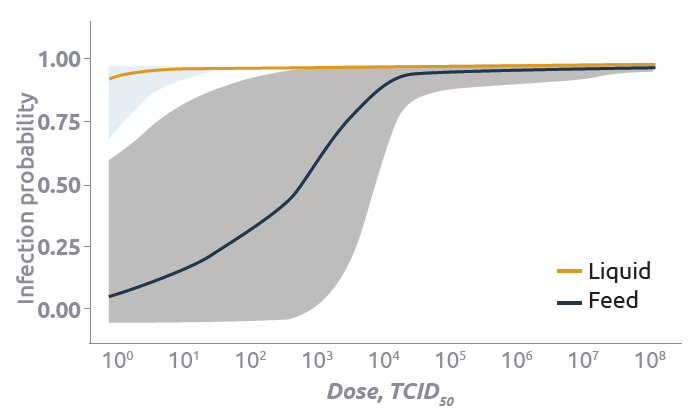
A retrospective study on the incursion of ASF in Romania during 2019 (Boklund et al. 2020) showed that the risk of an ASF event was approximately six times higher when cereals sourced from ASF positive areas were supplied to ASF negative regions. Additional work by Niederwerder et al. (2019) evaluated infectious ASF viral loads in feed and drinking water. The study demonstrated that although the probability of exposure to highly contaminated feed may be relatively low, the repeated daily exposure of pigs through feeders can substantially increase infection risk over time.
When models become operational reality
All those studies are valuable because they help estimate probabilities of occurrence. In practice, however, a farm or feed supply is either contaminated or not, and when that happens, immediate action is required.
A recent example in South Korea highlighted this reality when national authorities ordered the destruction of 500 tons of feed, aside from the culling of 150,000 pigs only in first quarter of 2026, after an epidemiological investigation suggested that blood from an infected pig may have contaminated the feed. This case not only highlights the importance of careful monitoring and traceability in preventing viral transmission through feed, but also confirms that biosecurity breaches can still occur despite preventive measures. Therefore, integrating proven virus-mitigating technologies into feed programs is essential to strengthen overall farm protection, much like installing fine-mesh fencing as an additional barrier against external threats.
FeedLock as part of a preventive biosecurity strategy
Free Medium Chain Fatty Acids (MCFA) belong to a category of feed technologies with proven antiviral activity, especially against enveloped viruses, in various types of feed. Compared to certain chemical mitigation approaches, MCFA technologies present no additional handling risks for operators. Their antiviral effects against major monogastric production viruses are documented in in silico, in vitro and in vivo studies.
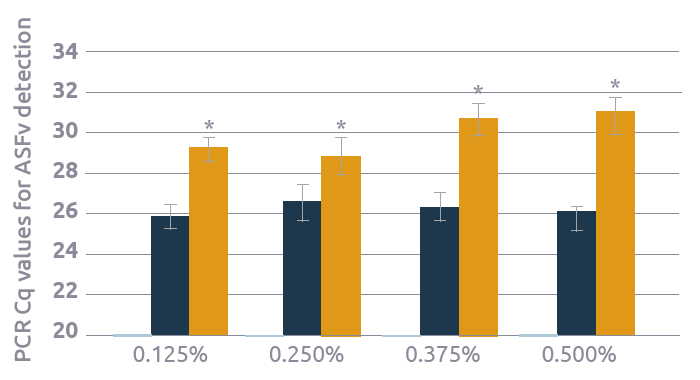
Royal Agrifirm Group has developed FeedLock, an optimized combination of free MCFA designed to provide time and dose-depending mitigation against viruses in feed. Preventive incorporation of FeedLock in feed can reduce ASFv particle loads by 5 to 26 times, corresponding to reductions of 2.3 to 4.7 Cq units.
Conclusion
The recent outbreak in South Korea confirmed that feed contamination, along with other biosecurity elements, is not simply a mathematical risk. It is a proven pathway for viral transmission that can have major operational and economic consequences for both farms and the wider industry. Investing in safe and validated feed-mitigating technologies completes the biosecurity belt that is needed to support an efficient operation of pig units.
For more information about FeedLock and its benefits, visit the dedicated product page: