Written by Marc Auffret (Project Manager R&D), Laurens Leemput (Nutritionist) and Cesar Bratz Riquelme (Global Species Lead Ruminants)
The dairy sector is facing a dual challenge: Farmers must meet the growing demand for milk, and, at the same time, reduce the environmental footprint of production. Enteric methane emissions from dairy cows are an important part of this discussion. With Anavrin®, Agrimprove is offering an innovative nutritional solution that supports methane reduction while maintaining milk production, animal health and welfare. Anavrin® is one of the solutions supporting our global ruminant approach. Results from both experimental and commercial trials demonstrate benefits for sustainability and farm profitability.
The dual challenge of robustness & sustainability in dairy production
Ruminants have played a valuable role in the human food chain for centuries. Their unique ability to convert inedible plant materials into high-quality food products, such as milk and meat, makes them essential to global food production. However, dairy production is facing increasing pressure. While demand for milk continues to grow, the sector is also being challenged to reduce its environmental impact, particularly greenhouse gas emissions such as methane.
Enteric methane emissions from ruminants are estimated to account for approximately 16% of global methane emissions. Several methane-reducing solutions are available on the market, including: 3-nitrooxypropanol (3-NOP), nitrate and, bromoform, which is naturally present in red seaweed such as Asparagopsis taxiformis. Although these solutions can be effective in lowering methane output, they act primarily by directly inhibiting rumen methanogenesis and usually offer limited additional benefits for animal performance, health or welfare.
Anavrin® supports sustainable dairy production
An alternative approach is to steer the rumen microbiome toward a more efficient and balanced ecosystem. In addition to reducing methane emissions, this strategy can also support productivity and animal well-being. Anavrin®, part of the Agrimprove portfolio, follows this approach.
Anavrin® is a coated blend of functional ingredients, including selected essential oils, tannins and bioflavonoids. This natural, unique, and complex formulation enables Anavrin® to act through multiple complementary mechanisms in the rumen, supporting rumen function and fermentation efficiency.
Based on a combination of scientific literature and trial observations, our hypothesis is that Anavrin® modulates the rumen microbiome by:
- Directly inhibiting specific methanogenic archaea,
- Shifting fiber-degrading bacterial populations, thereby reducing hydrogen availability for methane formation,
- Reducing total protozoa numbers and altering protozoal populations involved in hydrogen exchange,
- Stimulating rumen fermentation pathways that increase propionate production.
Together, these effects contribute to a sustained reduction in enteric methane emissions while supporting energy efficiency and milk production.
Proven methane reduction with performance benefits
Using gold-standard methane measurement techniques – such as metabolic chambers, GreenFeed systems (C-Lock Inc.), and SF₆ tracer methods – Anavrin® has been evaluated under both experimental and commercial farm conditions. When administered daily at a minimum inclusion of 3 g per cow, significant reductions in methane production, yield, and intensity have been observed.
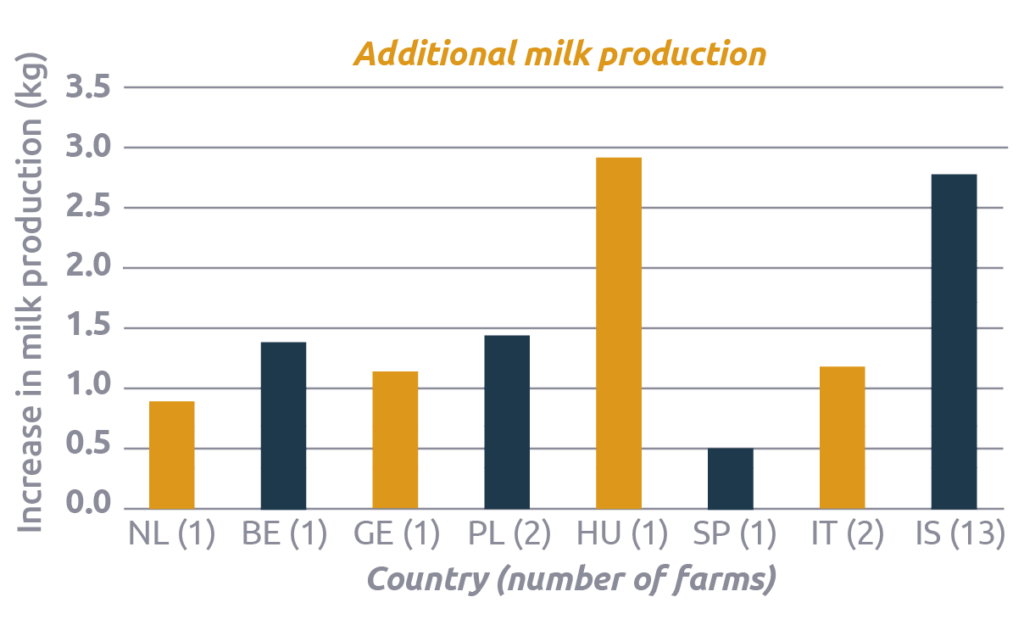
Across multiple independent trials, methane emissions were reduced by an average of 13% in cows receiving Anavrin® compared to control groups. Importantly, this methane reduction was achieved without compromising performance. In fact, trials have demonstrated positive effects on milk production, resulting in a favorable return on investment for farmers, starting from an average increase of 0.35 kg of milk per cow per day (Figure 1).
Supporting animal welfare during challenging periods
In addition to methane reduction and milk performance, Anavrin® also contributes to animal health and welfare. Its blend of protected essential oils provides antioxidant and immunomodulatory properties that can support cows during periods of physiological stress.
During the summer of 2025, mild to moderate heat stress was recorded over a 3- to 4-week period on commercial dairy farms in Belgium, Germany and Poland. Heat stress, confirmed using the Temperature and Humidity Index (THI), is well known to negatively affect feed intake, milk yield and overall cow health, often leading to economic losses.
Although a seasonal decline in milk production was observed, cows receiving Anavrin® showed a noticeably smaller drop in their lactation curve compared to both previous spring months and previous summer priods without Anavrin®. This indicates that Anavrin® helped support production stability and animal welfare during challenging environmental conditions (Figure 2).
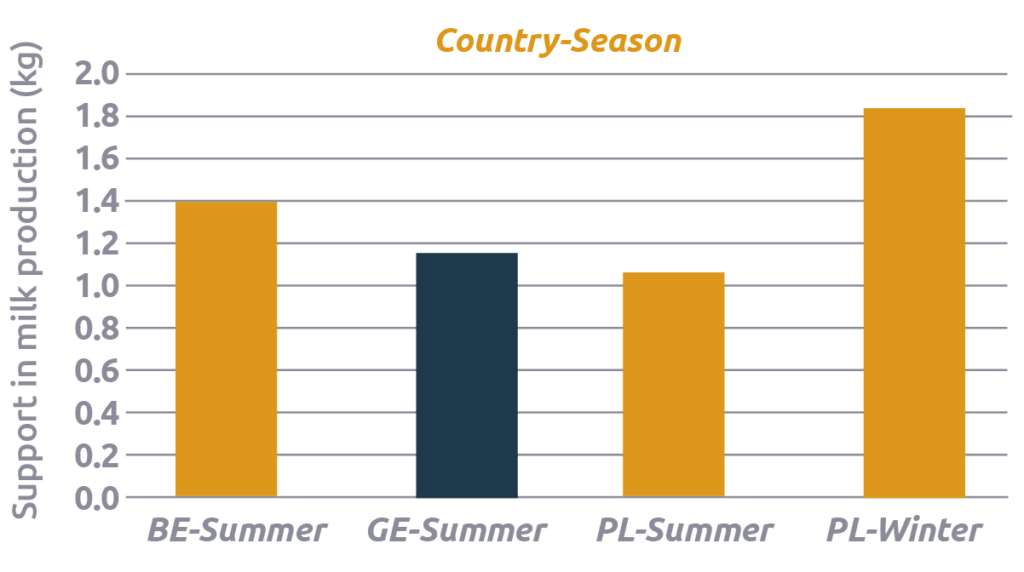
The trial was repeated on the same Polish farm during the winter of 2025, and additional milk production was again observed in cows supplemented with Anavrin®. These results confirm Anavrin®’s positive impact on dairy cow performance throughout the year.
Conclusion
By combining methane reduction with improved productivity and resilience, Anavrin® offers dairy farmers a practical tool to move towards more sustainable and future-proof production systems. The product demonstrates that environmental responsibility and economic performance can go hand-in-hand.